
I find that hyperbole has come to exhibit undue influence in modern discourse. In particular, I can sometimes be annoyed by the simplistic formulation 'Best/Worst. ____. Ever.'used to describe things and incidents which are by no means superlative within their given arenas. Simplistic notions of extremity have come to serve as basic shortcuts used to express vague notions or feelings towards something. This is the gateway to sloppy thinking.
So guess what, fuckos? I'm going to take this cute little catchphrase by the horns and put it out to pasture once and for all. I'm going to draw a line in the snow and tell you about
THE WORST. THING. EVER.
As Emperor of France, in 1812 Napoleon Bonaparte controlled an empire that stretched from Spain to the eastern edges of Poland. Unfortunately for Bonaparte, however, historical French rival Britain remained uncowed. This presented difficulties across a bevy of different dimensions. The Royal Navy still reigned supreme on the world's oceans, styming Napoleon's efforts to starve the island nation into economic submission via his blockade, the Continental System. Furthermore, a thriving black market for British goods on the European Continent (particularly in France herself) undermined Napoleon's political and personal prestige (to wit - the Grand Armee with which Napoleon would invade Russia in 1812 was outfitted with coats and boots that had been made in Britain). What was most unacceptable to the Emperor, however, was constant British intriguing in the politics of the continent and the UK's never ending overtures to build alliances bent on destroying the French Empire. Of these, the greatest threat was undoubtedly Russia - a virtually endless bastion of manpower, natural resources and hot chicks.
In any case, we are belaboring the point. What is salient is that, for some semi-good reasons, and many not-so-good reasons, Napoleon invaded Russia in 1812. Below is a rather famous chart depicting (rather ingeniously) both the approximate route of the French invasion and subsequent retreat, along with the ever evaporating strength of the once mighty Grand Armee. I've constructed a handy map legend:
Peach = advance
Black = retreat
Wide = Lots of guys
Narrow = Not so many guys

At the outset of the campaign, the Armee boasted more than 600,000 men, along with nearly half as many horses. Of these, only 22,000 men returned alive and, I don't know, like 6 horses.
Without getting too much into it, the whole operation was one long, shitty clusterfuck. Napoleon's army was not the highly trained and disciplined force it once was, scant attention had been paid to the logistical challenges of supplying such a massive force for hundreds of miles into the interior of the world's largest nation and the Russian generalship was more than happy to trade space for time, really only engaging the French in one large-scale battle, that of Borodino. For its part, Borodino was perhaps the bloodiest single day in the history of human warfare, but its resolution was (maddeningly for Napoleon) strategically inconclusive. Eventually, Napoleon would make it as far as Moscow, dithering for nearly thirty costly days while the early stages of winter set in. The march back would find the members of the French army subject to abduction, torture and death at the hands of a devastated Russian peasantry encountering their third marauding army in less than one year (the Russians retreating, the French advancing, the French retreating).
With the scene set, we can begin to discuss the horrors or the campaign.
(Ed. note: large portions quoted below are from Frank McLynn's incredibly thorough 1997 biography of Napoleon).
Our first scene is somewhat post hoc, but lends a good idea of the mood and dispositions of the characters involved. It takes place when the French have captured their first major Russian city, Smolensk:
The main French army began entering Smolensk at dawn on the 18th, to find it a smoking ruin and a charnel house of corpses; even hardened veterans vomited at the gruesome piles of dead and dying they saw . . . [Napoleon] was in a vindictive mood that day. Fires were still raging throughout the battle-scarred city and the Emperor, with ill-judged levity, described the devastation as a second eruption of Vesuvius. Point to the inferno still raging, he nudged Caulaincourt: 'Isn't that a fine specatacle?' 'Horrible, sire,' Caulincourt replied. Napoleon made a dismissive gesture. 'You should remember the saying of one of the Roman emperors: the corpse of an enemy always smells good."
After idling in Smolensk to contemplate his next move, Napoleon (against the advice of his marshals, ordered an advance on Moscow:
Once again the soldiers suffered terribly on the onward march. Stifled by dust and pelted by rain, they used improvised masks afainst sandstorms and were reduced to slaking their thirst with horses' urine because of shortage of water. Soon even that experiment became problematical, as the horses were dying by the thousands from starvation.
The advance was interrupted by the aforementioned Battle of Borordino. It's worthwhile here to make mention of the scale of the slaughter:
Some authorities claim that Borodino was the worst single day's fighting in all of history. The Grand Armee alone fired 90,000 artillery rounds and two million infantry cartridges. The Russians lost 44,000 dead and wounded and the French 35,000, though some historians claim this estimate conservative and suspect the true total for the day's casualties is 100,000; it seems that initial estimates of death tolls in Russian warfare are always timid . . . Even if we take the lowest plausible figure, a modern observer has commented that this is the equivalent of a Boeing 747 crashing with no survivors every five minutes for eight hours.
Despite failing to destroy the Russian army at Borodino, Napoleon soon took Moscow. What he did not anticipate was that the Russians would strip and burn their capital of anything of value to the advancing French. BY the time Napoleon took up temporary residence in the Kremlin, the city which only two weeks before had boasted a population of a quarter-million had scarcely more than 25,000 inhabitants scattered across the charred cityscape:
In the Kremlin, Napoleon was deluged with bad news. Communications with Smolensk were becoming increasingly difficult as the Spanish nightmare repeated itself, and semi-autonomous groups of peasant guerrillas sprang into existence . . .[One leader's] method was to greet the French with exaggerated courtesy, offer them food and drink, then slit their throats when they were drunk or asleep. The bodies would then be burned in pigsties or deep in forests, for French retaliation was swift if they ever discovered freshly turned graves near a village. Since so many patrols were ambushed by Russian partisans near Smolensk, Napoleon was forced to issue orders that no force less than 1,500 strong should ever leave the city.
As things grew more and more grim, Napoleon finally conceded that he had no choice but to retreat from Moscow. As the malnourished and suffering Grand Armee made its way back to the empire, though, they were set upon by a newly aggressive Russian Army. Fighting for his life, Napoleon elected to take an ill-advised course of retreat:
Next day they marched through the village of Borodino, skirting the battlefield. Psychologically, this had a disastrous effect on morale. Although the men tried to shield their eyes they could not avoid the sight of the 30,000 corpses on which wolves had fed, the immense tomb-like open grave into which bodies had been shoveled, the wheeling of carrion crows in the sky or myraid rotting corpses. At 2 a.m. on 30 October Napoleon asked Caulaincourt for a prognosis. He replied that things could only get worse: the weather would grow colder and the Russians stronger. The self-deceiving Emperor argued lamely that the superior native intelligence of the French would allow them to prevail.
It was on the long retreat that the Russian peasantry would exact its revenge on the invaders. Not just for their own incursion into the Russian motherland, but as a proxy for centuries of injustice and suffering:
The fortunate [French soldiers] taken by the partisans would suffer a quick if agonizing death, being impaled on stakes or thrown into vats of boiling water. For the less fortunate more hideous ends lay in store. The peasants would offer large sums to the Cossacks to be able to take over their prisioners. Then they would subject them to stomach-turning tortures: eyes were pulled out, nails hammered into the body, legs and arms cut off to leave a bleeding torso, stakes driven down the throat. One of two particularly favored methods was to wrap a naked victim in a wet sack with a pillow tied around the torsol villagers would then vie with one another to beat the stomach with hammers, logs and stones, so that the internal organs were crushed but no marks were left. Another was to raise the victim on a pulley with hands and feet tied together he would then be dropped so that the vertebrae in his back were broken. The process was continued until the prisoner was reduced to a spineless sack.
News of the fates that awaited them if captured ran through the ranks of the Frand Armee, causing terror . . . Lest it be thought that stories of Russian atrocities lost nothing in the telling, it is worth citing three instances recorded by Sir Robert Wilson, a British observer with the Russian army. After subjecting their prisoners to horrible tortures, the partisans first burnt a group of some fifty or sixty French troops alive; a second group of the same number was buried alive while for a third group . . . a kind of death by peasant bacchanalia was prepared. The prisoners were stripped naked, then spread eagled across a large felled tree with their necks protruding as if on the executioner's block; peasant men and women then hopped about singing in chorus while they beat out the prisoners' brains with hoes and cudgels.
Obviously, as word of these atrocities spread through the French army, the flight out of Russia took on an even more panicked atmosphere. Sir Robert Wilson:
The naked masses of dead and dying men, the mangled carcasses of 10,000 horses which had in some cases been cut for food before life had ceased; the craving of famine at other points forming groups of cannibals; the air enveloped in flame and smoke, the prayers of hundreds of naked wretches flying from the peasantry, whose shouts of vengeance echoed incessantly through the woods; the wrecks of cannon, powder-waggons, all stores of every description: it formed such a scene as probably was never witnessed in the history of the world.
As winter set on, things became even worse:
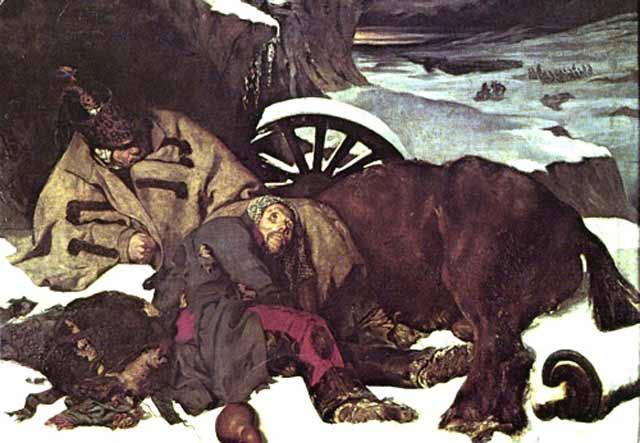
Food and drink could scarcely be had at any price. Many men were killed when they swallowed snow to quench their thirst. Steaks were cut from the haunches of horses on the hoof: number by the cold, the animals felt no pain/ Each dawn a line of ragged, bedraggled and increasingly shoeless men began dragging themselves through the snow, leaving behind a deserted camp-village of corpses, cannons and wagons. Many companies who managed to sleep in comfort around a roaring fire after dining on horseflesh lost the will to march on in the morning and were still apathetically sitting by their fires when the Cossacks or partisans caught up with them.
At this point, an attempted coup against his throne called Napoleon back to Paris. On 5 December, he left the army, whose suffering was not near an end. With temperatures dropping to -36 Fahrenheit, the death toll climbed yet further:
20,000 men dropped away in the three days between Smorgoni and Vilna. In the extreme cold it was common for 400 men to cluster around a fire at night and in the morning for 300 of them to be dead. Soldiers started setting entire houses on fire and standing round the flaming ruins all night. On the march to Vilna the food shortage was so acute that some men ate their own severed fingers and drank their own blood.
The French army would not reach the relative safety of Poland until 13-14 December, 1812. In all, nearly 600,000 Frenchmen had perished, along with an equitable amount of Russians soldiers and untold numbers from the Russian peasantry. The campaign of 1812 was the beginning of the end for Napoleon, who would be exiled twice from France by 1815, finally dying of stomach cancer on the lonely South Atlantic island of St. Helena. With the extremely arguable exception of the Holocaust -- a horror incomparable in scale -- nothing before or since has matched the French invasion of Russia for horrible texture of human misery, thus making the campaign the Worst. Thing. Ever.


 Posts


No comments:
Post a Comment